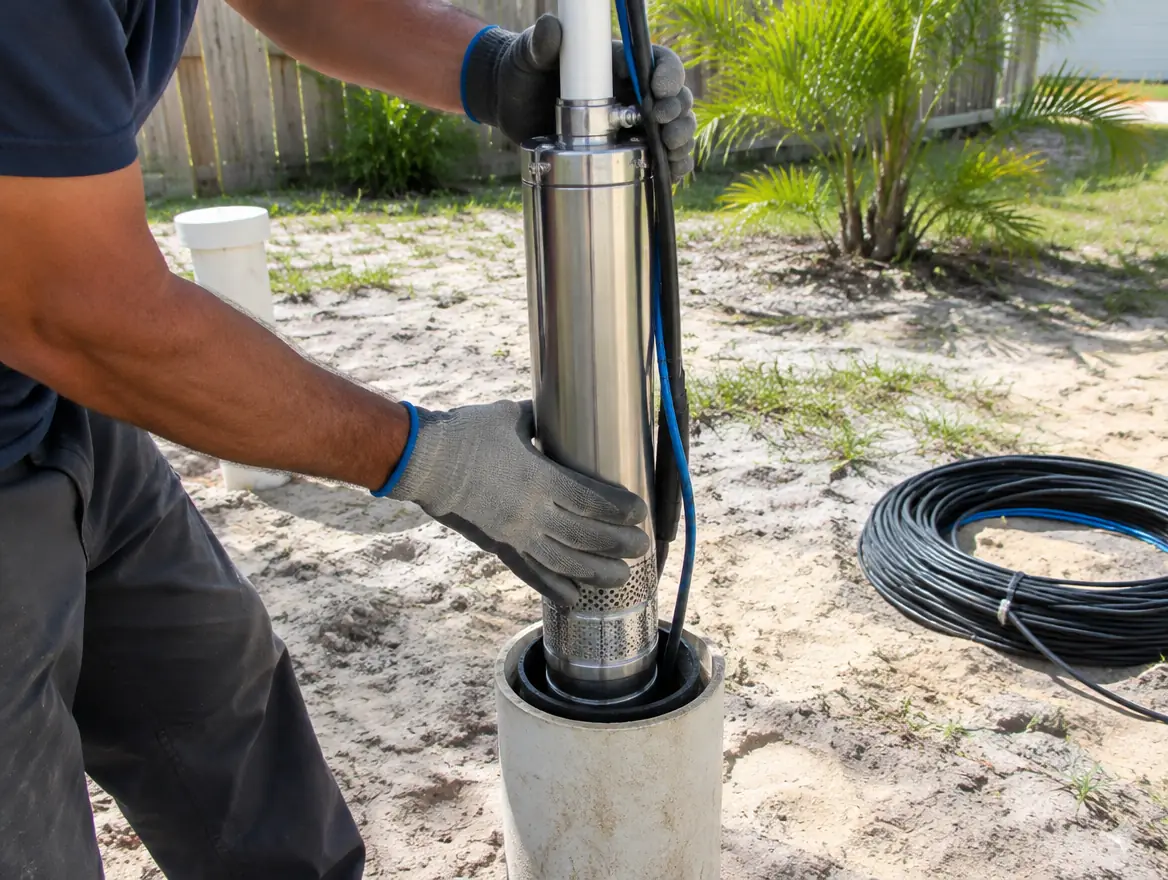
If all you can see in the yard is a well cap with a wire running into it, your pump is a submersible: a long, narrow motor and pump hanging down inside the casing. It's out of sight until it fails, and then it needs someone who can test it from the surface and pull it safely.
Call (321) 220-9883How a failing submersible shows itself
- No water, but the breaker is on and the switch is closed.
- Pressure that slowly gets worse over weeks.
- Sputtering, air or sand at the taps.
- Breaker trips as soon as the pump is called.
- The pump runs much longer than it used to.
Testing before pulling
A good contractor won't pull a pump on a hunch. Most of the answer comes from the surface: voltage at the switch, amp draw while running, and resistance readings on the motor leads. On three-wire pumps the control box above ground holds the start parts, and that's checked first because it's cheaper to fix than anything down the hole.
When it has to come up
Pulling means lifting the pump, drop pipe and wire out of the casing, inspecting the splice, check valve and pipe, and then repairing or replacing. Pipe and wire that are in poor shape are often replaced at the same time, since they'd have to come up again otherwise.
Submersibles around Melbourne
Submersibles are the norm where the house runs on its own well, and also show up on deeper irrigation wells. They're most often found on older and larger-lot properties outside the main city water lines.
Common questions
Can a submersible be repaired, or is it always replaced?
The motor and pump end are sealed, so a failed unit is usually replaced. But the fault is often above ground: the control box, switch or wiring.
Why did my submersible fail after a storm?
Lightning and surges travel through the power supply and can kill a motor or control box. Surge protection on the pump circuit helps.
How do I know if I have a submersible?
No pump beside the house, just a well cap with electrical conduit going into it, usually means a submersible.